
Will Trump’s Increased Wages And Restrictions On H-1B Visas Hold Up In Court?
Trump's interim final rule redefines H-1B specialty occupations and prevailing wages, hitting tech hard. Will these sweeping restrictions hold up in court?
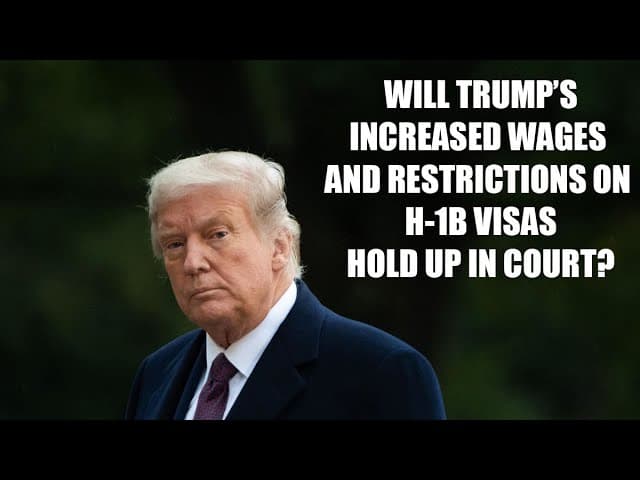
Following President Trump’s recent proclamation, the Department of Labor and the Department of Homeland Security issued sweeping regulations on the definition and requirements for “specialty occupation”, the basis of the H-1B visa and the prevailing wage, the amount of money that must be paid to H-1B workers.
The impact of this Interim Final Rule will be massive, especially on the tech sector, where the occupation of software developer and others have been virtually eliminated, and such roles comprise 40% of all H-1B visas issued.
But other professions that use the H-1B will also be negatively affected, because the wage requirements have now been set so artificially high that it will be impractical for employers to hire entry-level workers.
This will cause jobs to leave the United States, which contradicts one of the major promises that President Trump said he would address.
It will continue to impact foreign students who want to come to American Universities, as it will be significantly harder for them to enter the U.S. workforce at a later date, as long as these new regulations remain in force.
But will the courts uphold these new rules?
Looking at the Trump Administration’s track record in similar cases, this is not very likely.
What is different in this current situation is that the Administration used regulations instead of Presidential proclamations. Proclamations have been shot down hard recently as unconstitutional.
While comprehensive Agency regulations may be harder to challenge than Presidential proclamations, the case will likely turn on the use of an Interim Final Rule.
The Administrative Procedures Act authorizes an Agency to issue a rule without prior notice or opportunity for comment when the Agency, for good cause, finds that those procedures are impracticable, unnecessary, or contrary to the public interest, so may apply in emergency situations (the most common circumstance).
Watch the video to get the full details.
Related Posts
On October 6, 2020, a new interim final rule limited the scope and term of H-1B visas and cracked down on employers. Here's what changed and who's affected.
The Trump administration's introduction of an unprecedented $100,000 fee for new H-1B visa applications
The H-1B visa program, a lifeline for skilled foreign professionals aspiring to work in the United States.
Related Visa Guides
The nonimmigrant H-1B visa allows U.S. companies to employ foreign nationals with theoretical or technical knowledge in a specialty occupation.
The EB-3 visa is a third preference employment-based green card for skilled, professional, and in some cases "unskilled" workers.
The EB-5 Investor visa allows permanent US residency (Green Card) to foreign investors who can invest significant capital in US companies.