
H-1B Visa in 2025 – Complete Guide for Workers & Employers
A complete 2025 guide to the H-1B visa for workers and employers, covering specialty occupations, dual intent, rising scrutiny, site visits, and evidence.
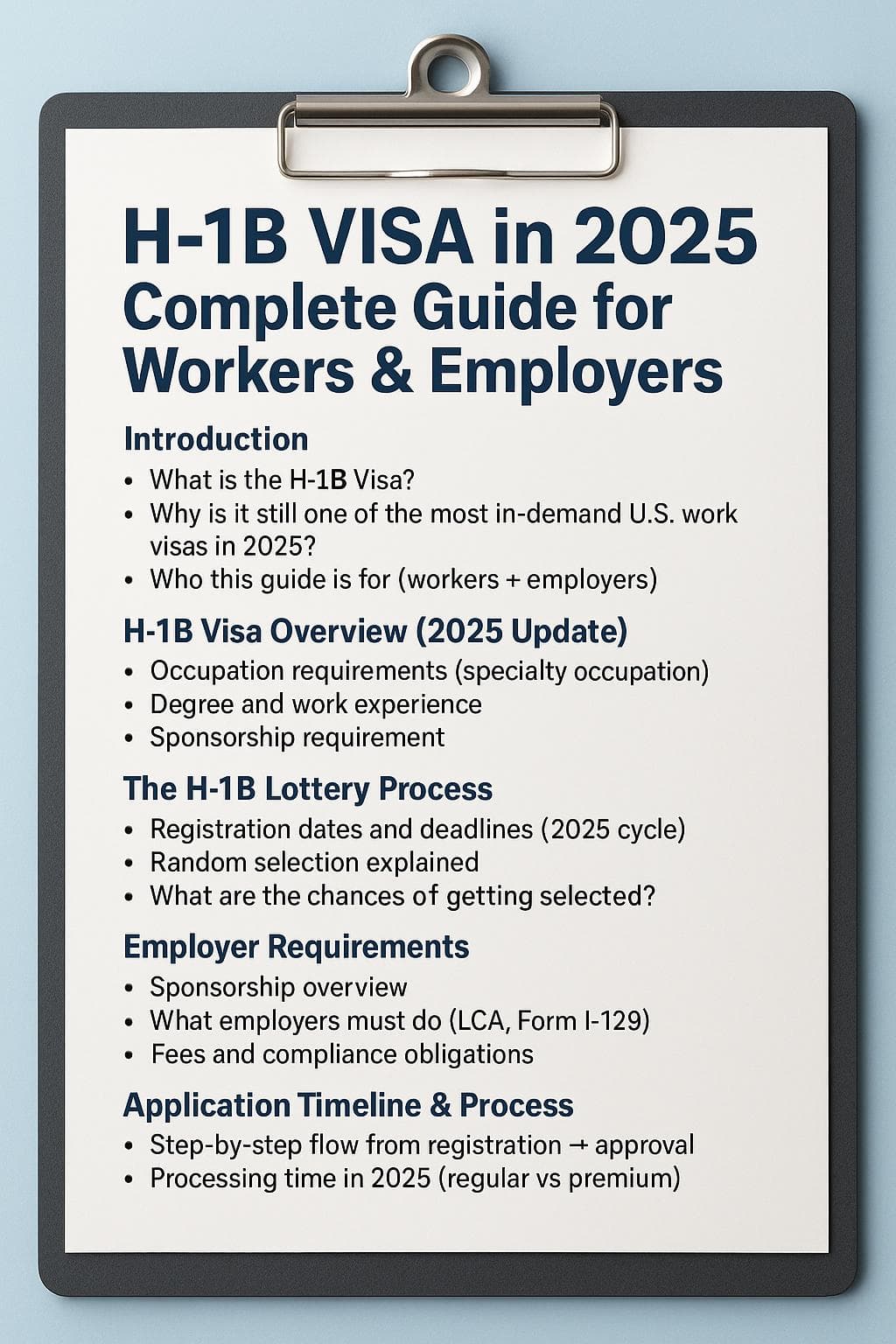
I. Introduction
The H-1B visa is a nonimmigrant visa that allows U.S. companies to employ foreign workers in specialty occupations. In 2025, it remains one of the most sought-after work visas due to its dual intent nature and potential pathway to permanent residency. However, recent administrative changes have made the process more cautious, especially for smaller employers. Increased site visits and higher scrutiny mean every detail must be verifiable and supported by evidence.
This guide is designed for both foreign professionals and U.S. employers navigating the more rigorous landscape of H-1B sponsorship today.
📌 Learn more: H-1B Visa Overview
II. H-1B Visa Overview (2025 Update)
The H-1B visa allows foreign nationals to work in the U.S. in specialty occupations, typically requiring a bachelor’s degree or higher. It grants an initial stay of three years, extendable to six years, and supports dual intent—meaning holders can pursue a green card while on H-1B.
What’s New in 2025:
-
Updated cap limits: Regular cap (65,000), Master’s cap (20,000)
-
New electronic registration deadlines
-
Heightened scrutiny during adjudication, particularly for companies without full-time operations or clear office locations
-
Increased site visits from USCIS to verify legitimacy of employment
III. Who Qualifies for the H-1B?
To qualify for an H-1B visa, the position must:
-
Require a specialty occupation
-
Typically need a bachelor’s degree or higher in a specific field
-
Be offered by an employer willing to sponsor the visa
Applicants must also have:
-
A relevant U.S. or foreign degree (or equivalent experience)
-
A job offer from a U.S. employer
⚠️ Employers should be prepared to document and demonstrate the job’s legitimacy and operational structure. Inadequate evidence or vague job descriptions can lead to denials.
IV. The H-1B Lottery Process
What are the H-1B registration dates for 2025?
- Registration window: March 1–March 17, 2025 (tentative)
How does the lottery selection work?
USCIS uses a random selection process for:
-
Regular Cap (65,000 visas)
-
Master’s Cap (20,000 additional for U.S. advanced degree holders)
What are the chances of getting selected?
Chances vary yearly but typically range between 15%–30% depending on the number of registrations.
V. Employer Requirements
Employers must:
-
File a Labor Condition Application (LCA) with the Department of Labor
-
Submit Form I-129 to USCIS
-
Pay relevant fees (filing, fraud prevention, ACWIA, premium processing if chosen)
-
Maintain compliance, including wage obligations and record-keeping
**Caution for Small Companies:**USCIS has increased site visits and now scrutinizes smaller companies more closely. If your company doesn’t have full-time staff, a physical office, or clear business operations, your H-1B application may face serious risk of denial.
VI. Application Timeline & Process
-
March: Electronic registration opens
-
April: Lottery results announced
-
April–June: Petition filing period
-
June–October: USCIS adjudicates cases
Processing Times in 2025:
-
Regular: 3–6 months
-
Premium: 15 calendar days (with fee)
VII. Common Reasons for Denial
-
Role does not qualify as a specialty occupation
-
Lack of evidence of employer-employee relationship
-
Wage offered is below prevailing level
-
No proof of legitimate operations (especially for small or remote businesses)
VIII. What Happens After Approval?
-
Visa stamping at a U.S. embassy or consulate
-
Entry to U.S. up to 10 days before job start date
-
Maintain status through employment and reporting
**Path to Green Card:**Many H-1B holders later apply for employment-based green cards, typically via EB-2 or EB-3 categories.
IX. Alternatives if You Don’t Win the Lottery
-
Cap-Exempt H-1Bs: Universities, nonprofits, and research institutions
-
Other Visas:
-
O-1 (extraordinary ability)
-
TN (Canada/Mexico under USMCA)
-
E-2 (investors)
-
L-1 (intra-company transfers)
-
-
Reapply Next Year: Improve qualifications, consider master’s degree
X. Need Help? Schedule a Strategy Session
Not sure how to proceed? Get tailored advice from a top immigration attorney.
Related Posts
An investigation reveals a widespread conspiracy to manipulate the H-1B visa process, undermining American workforce opportunities.
USCIS: H-1B Cap Season Starts April 1, Early Applications to Be Rejected, Premium Processing Prioritizes I-129s Filing Change of Status.
Jan 30 2019 DHS final rule delays digital pre-registration requirement and reorders allocation of H-1B visas, potentially reducing overall H-1Bs.
Related Visa Guides
The nonimmigrant H-1B visa allows U.S. companies to employ foreign nationals with theoretical or technical knowledge in a specialty occupation.
The EB-3 visa is a third preference employment-based green card for skilled, professional, and in some cases "unskilled" workers.
The EB-5 Investor visa allows permanent US residency (Green Card) to foreign investors who can invest significant capital in US companies.